Start by identifying the batteries
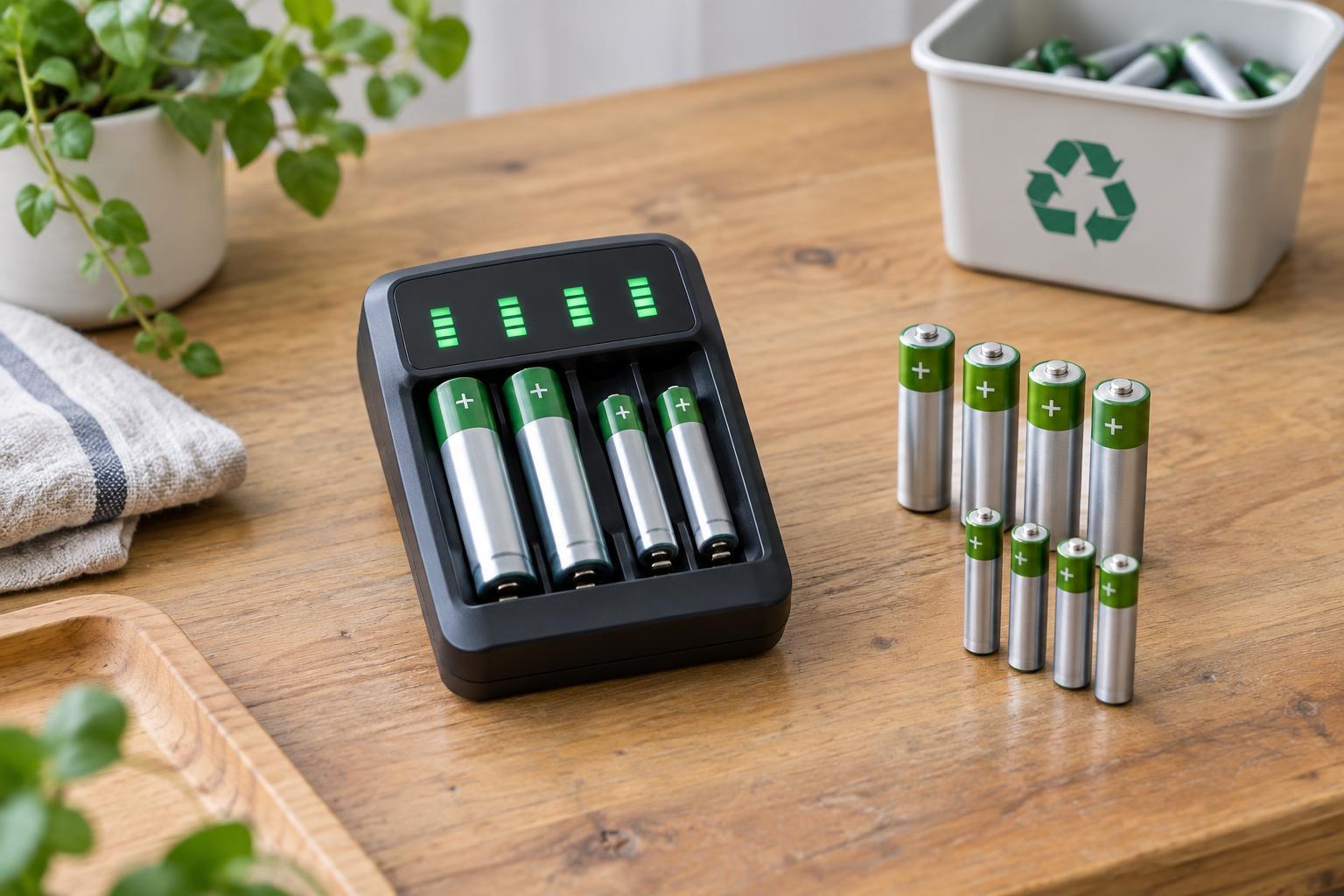
Most familiar rechargeable AA and AAA household batteries use nickel-metal hydride chemistry, marked “NiMH” on the wrapper. Before testing, read each label and check the charger’s instructions. Use only a charger that explicitly supports the battery’s chemistry and size. A cell being AA- or AAA-shaped does not make it compatible: lithium-ion cells of similar dimensions need different charging equipment. Never try to charge a disposable alkaline battery.
Inspect each cell before it goes into the charger. Set aside batteries with leaks, corrosion, a damaged wrapper, dents or other visible damage. Do not scrape deposits off a cell for a test, open it or bridge its terminals with metal. Follow local battery-collection guidance for cells you cannot safely reuse.
Choose a test your charger can perform
A basic consumer charger may tell you only whether a charging cycle has finished. That is useful, but it does not measure how much energy the battery will deliver in a device. For a more informative check, look for a NiMH-compatible charger with a test or capacity mode that charges, discharges and recharges cells. Read its manual to learn what its display means and whether it tests each slot separately.
Capacity is usually shown in milliamp-hours, or mAh. A discharge-capacity reading estimates how much charge the charger removed from a cell during its controlled test. A number labelled “charged” or “input” mAh instead describes what the charger put in; it is not the same as measured discharge capacity. Voltage by itself is also a poor guide to remaining NiMH capacity, even when a charger displays it.
Run a safe, repeatable test
Place the charger on a dry, stable, ventilated surface and use it as its manufacturer directs. Check that the charger, power supply and contacts are in good condition. Insert each AA or AAA cell in the correct orientation, select the appropriate NiMH test mode and use a charging current suitable for that cell according to the charger’s instructions. Do not leave batteries where children or pets can disturb them.
Record the cell’s label, size and displayed result so you can compare it with later tests. If practical, test similar cells using the same charger settings; changing the test current can change the result. A capacity test may take much longer than an ordinary charge because it includes a controlled discharge. Some warmth can be normal, but if a cell or charger becomes unusually hot, smells odd or shows damage, stop using it and follow the equipment’s safety instructions.
Interpret results in the context of use
Compare a measured discharge capacity with the cell’s labelled capacity and with other cells tested under similar conditions. A lower reading does not automatically mean the cell is unusable: an older cell may still serve a low-demand device well. A cell that tests much lower than its partners, fails the charger’s test or repeatedly gives a short runtime is a less dependable choice for a device that uses several cells together.
If a result seems surprising, check the charger’s manual before drawing a conclusion. Some chargers use a preparation cycle or offer different modes, and a single reading may not tell the whole story. You can repeat a test with the same settings if the cell remains in good condition. Avoid treating a precise-looking display as a guarantee of how long the battery will run every device.
Keep useful cells together and recycle the rest
Mark reusable cells discreetly so you can recognize them without covering their labels or damaging their wrappers. In a device that takes multiple batteries, use cells of the same chemistry and size with reasonably similar tested performance, and charge them according to the device and charger instructions. Keeping a set together makes an unexpectedly short runtime easier to investigate.
Retire cells that are damaged, leak, cannot complete a compatible charger’s cycle or no longer meet your practical needs. Keep loose batteries from contacting keys, coins or one another’s terminals during storage and transport; follow your local collection program’s instructions for preparing them for recycling. Testing is worthwhile when it helps you reuse sound batteries with confidence, not when it gives a reason to keep an unsafe one in service.