Why current protection matters
A short circuit or stalled load can draw more current than a wire, connector, circuit-board trace, or component can safely carry. An overcurrent protection device helps limit the consequences by changing how much current can flow. It does not prevent every failure: its location, ratings, and the available power from the source all matter.
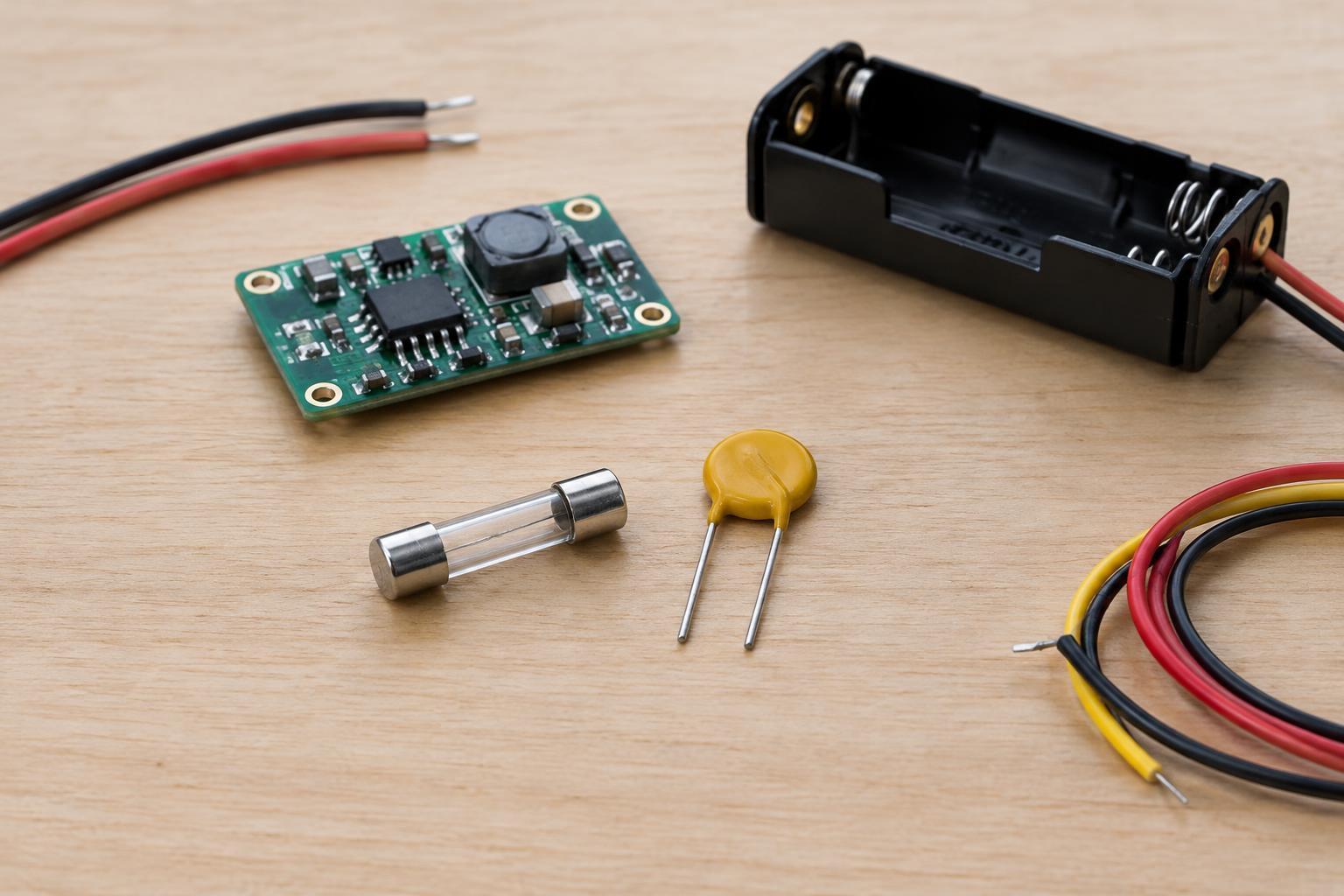
Fuses and resettable positive temperature coefficient devices, usually called PTCs, are common choices for low-voltage circuits. Both respond to excess current by heating, but their outcomes differ. A fuse is intended to open the circuit permanently. A PTC increases its resistance substantially and may return to a low-resistance state after the fault is removed and the device cools.
What a fuse does
A fuse contains an element designed to melt when enough current flows for enough time. Once it opens, it must be replaced with the correct type and rating. That replacement step is inconvenient, but it also makes a fault visible and discourages repeated operation without investigation.
A fuse's printed current rating is not a promise that it will open the instant that current is reached. How quickly it opens depends on the amount of excess current and the fuse's time-current characteristics. Some fuses tolerate a brief startup surge better than others. Selection also requires an appropriate voltage rating and an interrupting rating suitable for the current the power source could deliver into a fault. A fuse with an inadequate interrupting rating may not safely clear that fault.
Use a fuse when opening the circuit is the desired response, especially when continued current after a fault would be unacceptable. Install it in series, as close as practical to the power source, so the wiring after it is protected. A fuse cannot protect a section of wire between itself and the source.
What a resettable PTC does
A resettable PTC is normally low in resistance. Excess current heats it, causing its resistance to rise sharply and reducing the current. It remains hot while power and the fault are present; after power is removed or the fault clears, it can cool and reset. Unlike a fuse, a tripped PTC does not necessarily create an open circuit. Some current can continue to flow, so it is a poor substitute where complete disconnection is required.
Datasheets commonly distinguish hold current, below which the PTC should remain in its low-resistance state under specified conditions, from trip current, at which it should change state under specified conditions. The space between them is not a precise switching threshold. Ambient temperature, nearby heat sources, board layout, and airflow can change its behavior. Its normal resistance also causes a voltage drop that may matter to a low-voltage device.
PTCs can be useful where occasional, recoverable faults are expected and automatic recovery is acceptable. That convenience has a trade-off: if a short remains, the device may stay hot, and a circuit may repeatedly resume operation as conditions change. Check the PTC's maximum voltage and fault-current ratings as well as its thermal behavior.
Choosing and placing protection
Start by identifying the normal operating current, including startup peaks, and the smallest current that the wiring and connected parts can safely tolerate for the likely fault duration. Then consider how much current the source could supply into a short circuit. The protection device must allow normal operation while responding appropriately to faults; neither a fuse nor a PTC can compensate for undersized wiring or an unsuitable power source.
For a small low-voltage project, ask what should happen after a fault. If someone should inspect and repair the circuit before it runs again, a fuse may be the better fit. If recovery without replacement is important and a reduced but nonzero fault current is acceptable, a PTC may be suitable. A PTC can also protect an individual branch while a correctly rated fuse provides upstream protection, but their coordination needs checking rather than assuming either will act first.
Work only with low-voltage supplies you understand, and disconnect power before changing components or investigating a fault. Do not replace a fuse with a higher-rated one merely because it opens, or bridge it with wire. For mains-powered equipment, high-energy battery packs, or circuits whose failure could cause injury or fire, use an appropriately engineered protection design rather than treating a general fuse-or-PTC comparison as a design specification.