Two different ways to sense temperature
A digital temperature IC contains a sensing element and circuitry that converts its reading into a digital value. A microcontroller can usually read that value through a digital interface. The IC measures its own temperature, which may be close to the temperature of the surrounding air, a circuit board or a surface it touches. It does not automatically measure the temperature of an object some distance away.
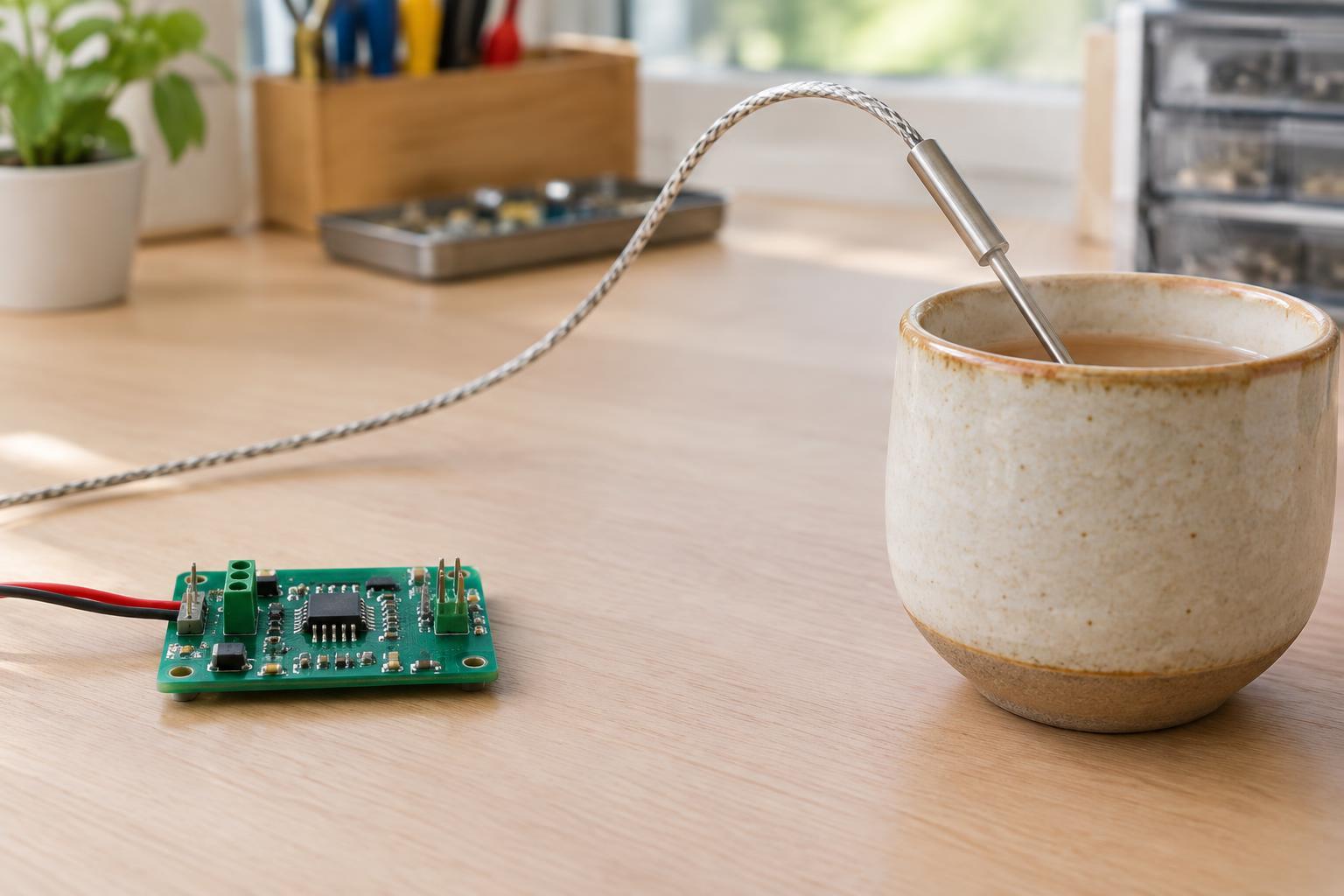
A thermocouple is a junction of two different metals. A temperature difference between the measuring junction and the other ends of its wires produces a small voltage. A suitable interface circuit interprets that voltage as a temperature reading. The junction can be at the tip of a probe while the electronics remain elsewhere, making thermocouples useful where placing an IC at the measurement point would be impractical.
Range starts with the entire assembly
Digital temperature ICs are generally a straightforward choice for temperatures within the operating limits of ordinary electronics. They can be useful for monitoring an enclosure, checking whether a low-voltage board is warming up or measuring conditions near a sensor module. Their usable range is limited by the specified operating range of the particular IC and by its package and mounting materials. A device that can report a number outside its rated conditions is not necessarily making a valid measurement there.
Thermocouples are often chosen for measurement points that are too hot for a typical digital IC. But the metal junction is only part of a probe: its insulation, sheath, connector and wire routing also have temperature limits. Different thermocouple types and probe constructions have different usable ranges. Check the ratings of the complete probe and interface, rather than assuming that every thermocouple can withstand the same conditions.
What limits the accuracy of each reading?
A digital IC may provide a finely spaced digital reading, but resolution is not the same as accuracy. Its stated accuracy applies under conditions given in its datasheet. Heat from nearby components, airflow, a poorly chosen mounting position or the IC’s own small amount of self-heating can make its temperature differ from the temperature you intended to measure. If the goal is ambient air temperature, keep it away from warm regulators and give air a path to the sensor.
A thermocouple interface must measure a very small voltage and account for the temperature where the thermocouple wires meet the measurement electronics. This is called cold-junction compensation. Errors in that compensation, electrical noise, unsuitable extension wire or an interface configured for the wrong thermocouple type can affect the result. Probe contact matters too: a tip that is loose on a surface may read differently from one held in firm contact. A thermocouple’s ability to survive a high temperature does not, by itself, guarantee a more accurate reading.
Placement and response matter as much as specifications
Choose the sensor around the temperature you actually need to know. For a low-voltage enclosure, an IC mounted away from heat-producing parts may provide a useful indication of internal air temperature. If it is attached directly to a warm board, it may instead track the board. Labelling the measurement point clearly helps prevent a reading from being mistaken for the temperature of another part of the device.
A thermocouple’s small junction can respond quickly when it has good thermal contact, but a heavy protective sheath may respond more slowly. Wire length and routing can also make installation more complicated. Conversely, a digital IC may be easier to connect yet slower to reflect a change in a distant object because heat must travel through its mounting. Compare datasheet conditions and probe construction when response time matters; do not infer it from sensor type alone.
A practical choice for a low-voltage project
Start by listing the expected temperature range, the exact measurement point, the environment and the accuracy you need. For accessible, electronics-friendly temperatures and simple digital wiring, a temperature IC is often the easier starting point. For a point that must be reached by a probe or is beyond an IC’s rated range, consider a thermocouple with a matching interface that provides cold-junction compensation. In either case, verify the assembled setup at a known, safe condition before relying on its readings.
Keep the project within your electrical and thermal skills. A low-voltage sensor board does not make a hot surface safe to touch, and a metal thermocouple probe may conduct electricity if placed against a live part. Do not attach a hobby measurement setup to mains wiring or exposed high-voltage equipment. Use appropriate separation and rated equipment for the environment, or leave that measurement to a qualified person.