What a diode does
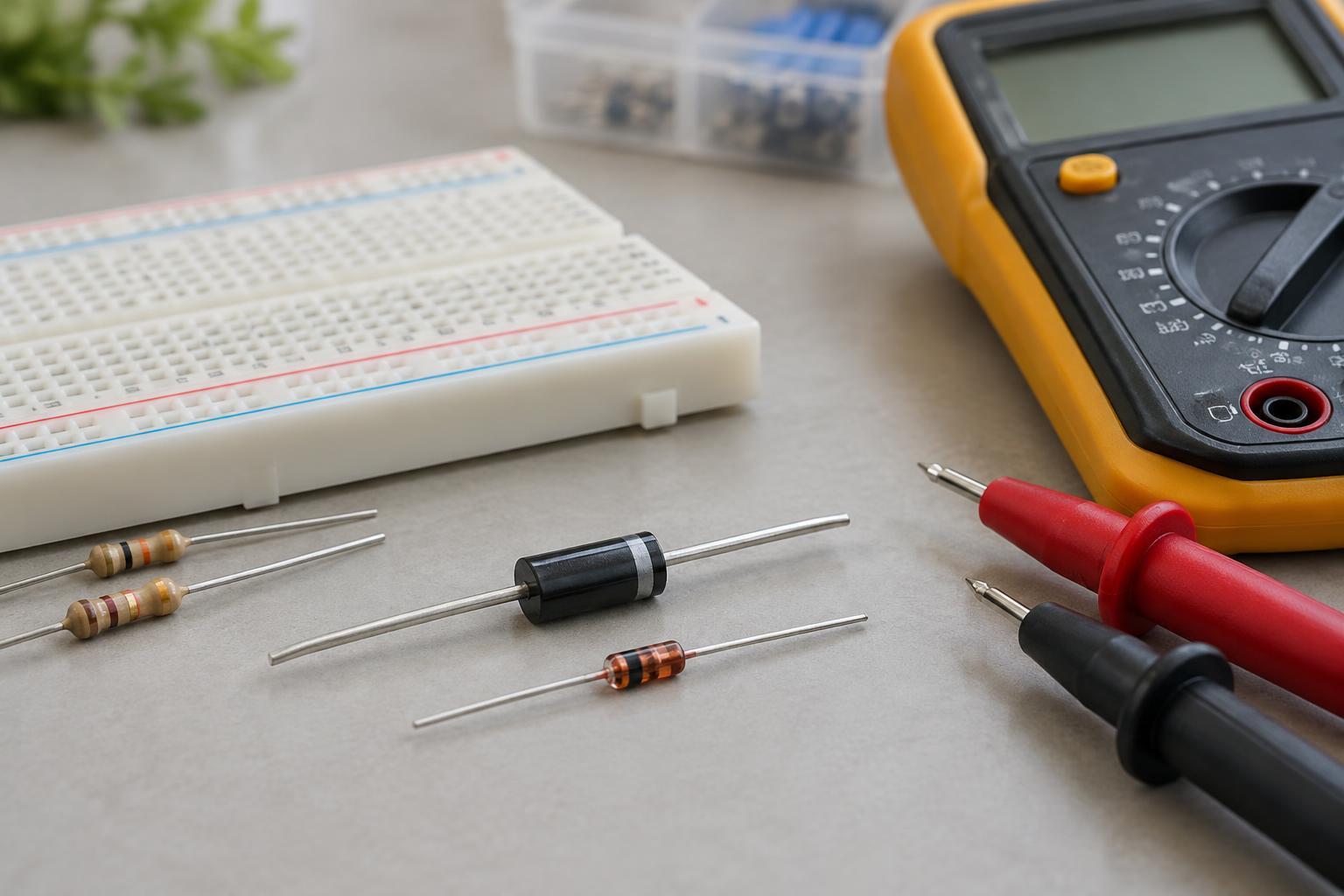
A diode is a two-terminal component that conducts readily in one direction and blocks current in the other, within its rated limits. Its terminals are the anode and cathode. In ordinary forward operation, conventional current flows from anode to cathode. On many common diodes, a band on the body identifies the cathode; a diode symbol’s bar identifies that same terminal. Package markings can vary, so check the part’s documentation when the marking is unclear.
A signal diode is commonly used where currents are modest, such as steering a logic signal or detecting a waveform. A rectifier diode is generally chosen to handle more current in applications such as converting an alternating input to a one-directional output. These are useful descriptions, not guarantees about any particular part. Two diodes that look alike may have very different limits, and a physically larger diode is not automatically suitable for every circuit.
Polarity depends on the job
In a simple low-voltage circuit, a diode placed in series with a load will conduct when its anode faces the positive supply and its cathode faces the load. Reverse it, and it will normally block the supply. That blocking behavior is useful for some forms of reverse-polarity protection, though the circuit must tolerate the voltage lost across the diode.
Not every correctly installed diode points in the direction of normal supply current. A diode placed across a small DC relay coil, for example, is normally reverse-biased: its cathode goes toward the coil’s positive supply and its anode toward the other end of the coil. When the coil is switched off, the diode provides a path for the coil’s current. Installing that diode the other way round can create a near-short when power is applied. Before fitting a diode, identify both its terminals and the purpose it serves in that position.
Forward voltage is not a fixed number
When a diode conducts, it has a forward voltage drop. You may see a silicon diode described using a rough figure of 0.7 V, but that is only a starting point for thinking about a circuit. The actual drop depends on the particular diode, its current, and its temperature. A datasheet usually states forward voltage at one or more specified currents; those test conditions matter more than a single remembered number.
This drop affects both the load and the diode. In a low-voltage supply path, the load receives less voltage than the source provides. The diode also produces heat: an estimate of its dissipation is forward voltage multiplied by forward current. A diode that seems acceptable by current rating alone may run too hot if it conducts heavily or sits in a warm enclosure. If a circuit has little voltage to spare, compare diode types and their specified behavior at the expected current rather than assuming all forward drops are alike.
Read ratings as operating limits
Start selection with the voltage the diode must block when reverse-biased. Its reverse-voltage rating must exceed the greatest reverse voltage expected in the circuit, with room for foreseeable variation or transients. Also check its forward-current rating against the current it must carry. Datasheets may distinguish average current from short surge current; a brief surge allowance does not mean the diode can carry that current continuously.
Ratings depend on conditions. Current limits may assume a particular ambient temperature, lead length, circuit board area, or method of cooling. A rectifier’s current rating can therefore overstate what it will comfortably handle in a cramped, hot assembly. Switching speed matters too: a diode suitable for low-frequency rectification may not behave as intended in a fast-switching circuit. For an unfamiliar part, use its datasheet to compare the relevant ratings and test conditions with the circuit, rather than relying on a part number’s reputation.
A safe way to check a diode
For a basic check, disconnect power and use a multimeter’s diode-test mode. With the red probe on the anode and black probe on the cathode, a healthy conventional silicon diode will often show a forward-voltage reading. Swap the probes and the meter should usually indicate no conduction. The exact display varies by meter and diode type. Other components connected in parallel can affect an in-circuit reading, so an ambiguous result may require lifting one diode lead before testing again.
Keep hands-on checks to isolated, low-voltage, current-limited circuits appropriate to your skill level. Do not probe a powered mains circuit to identify a diode, and remember that capacitors can retain charge after power is removed. If a diode fails repeatedly, replacing it with a higher-rated part without finding the cause may only hide an overload. Check its orientation, the expected current, the reverse voltage, and nearby components before powering the circuit again.