What an inductor does
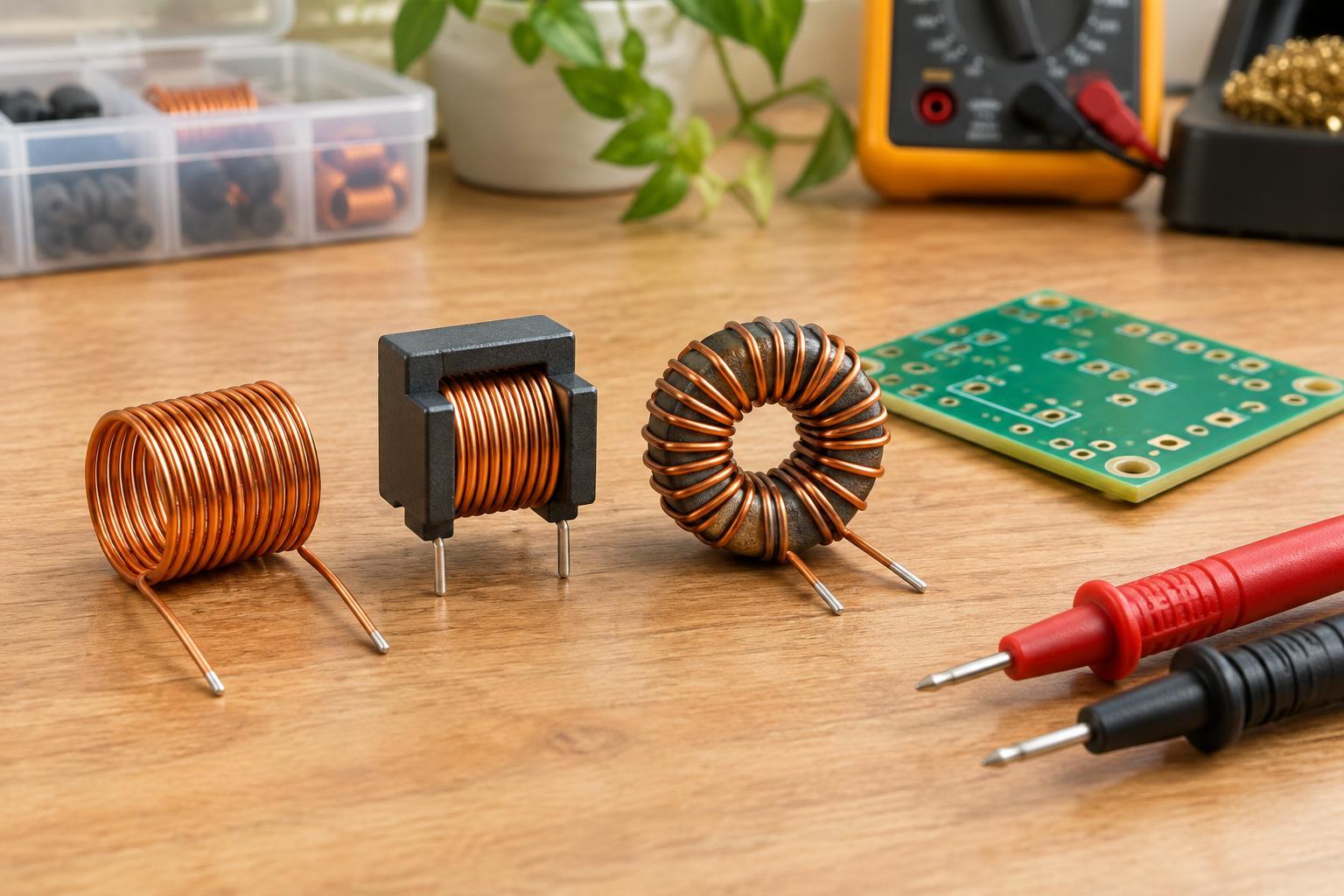
An inductor is a conductor wound into a coil, sometimes around a magnetic core. When current flows, the coil creates a magnetic field and stores energy in it. If the current tries to change, the changing field produces a voltage that opposes that change. This makes inductors useful for smoothing current, filtering signals, and transferring energy in switching circuits.
Inductance describes how strongly a component resists a change in current. It is measured in henries, though microhenries and millihenries are more common in consumer electronics. A higher inductance generally means current changes more slowly under the same applied voltage. Inductance does not mean resistance to steady direct current: a real coil also has wire resistance, but an ideal inductor would have none once its current became constant.
Inductors appear in power converters, radio-frequency circuits, and filters. Their behavior depends on more than the value printed beside them on a schematic. Current level, operating frequency, winding resistance, and core material can all change how well a particular part works.
Reading an inductance value in context
An inductance value is a starting point, not a complete specification. In a switching power circuit, it helps determine how much the current rises and falls during each switching cycle. Too little inductance may allow excessive current ripple; too much can make the circuit respond differently from its intended design. The appropriate value depends on the circuit, so replacing an inductor with one that merely looks similar is unreliable.
Inductance may vary with current and frequency, especially when a magnetic core is involved. A datasheet might state the test conditions and an allowed tolerance, such as a percentage above or below the nominal value. Compare parts using conditions relevant to the circuit rather than treating two identical-looking labels as proof of identical performance.
At higher frequencies, winding capacitance and core losses also matter. An inductor has a self-resonant frequency above which it no longer behaves like a simple inductor. For signal filters or radio-frequency work, that specification and the part's physical layout can be as important as its nominal inductance.
Why there may be more than one current rating
Current ratings describe different limits. Saturation current is the current at which a magnetic core can no longer support its expected inductance; manufacturers may define the rating by a specified percentage drop. A saturated inductor offers less opposition to changing current, which can lead to larger current peaks in a power circuit. The exact threshold depends on the part and how its rating is defined.
A temperature-rise or rated current describes heating under specified conditions. Current flowing through the winding produces heat because the wire has resistance, often listed as DC resistance or DCR. Core losses can add heat when current changes rapidly. A part can stay below its saturation limit yet run too hot, or stay relatively cool while its inductance has already fallen substantially.
When choosing a replacement, check both kinds of current limit and allow for the circuit's peak current, not just its average current. Compare DCR, dimensions, and mounting style as well. A lower DCR often reduces winding losses, but a physically larger part may not fit or may affect nearby components.
How core materials change the trade-offs
An air-core inductor has no magnetic core to saturate, making its inductance comparatively stable as current rises. It often needs more turns or a larger coil to achieve a given inductance, however, and its magnetic field may couple into nearby circuits. Air-core parts are often considered where stable behavior at higher frequencies matters.
Ferrite cores can provide substantial inductance in a compact package. Different ferrite materials are suited to different frequency ranges, so “ferrite” alone does not identify an interchangeable part. Ferrite-core inductors can lose inductance sharply as they approach saturation. A shielded construction can help contain stray magnetic fields, although shielding does not remove the need to check ratings.
Powdered-iron cores contain magnetic particles separated by insulating material. Their distributed gaps can make the change in inductance with rising current more gradual than it is for some ferrite designs. Material grades differ in frequency behavior and losses. Neither powdered iron nor ferrite is universally better; the circuit's current, frequency, size limits, and acceptable losses guide the choice.
A safe way to identify or replace one
Start with the circuit's part number or schematic if available. Record the inductance, tolerance, saturation and heating ratings, DCR, physical size, and core or shielding requirements. If those details are unavailable, measuring an unmarked part may help identify it, but an ordinary measurement at low current cannot establish its behavior under the circuit's full load.
Keep hands-on checks to disconnected, low-voltage equipment within your skill level. Remove the power source before handling a board, and remember that capacitors can retain charge after power is removed. Do not use a low-voltage inductor guide to select parts for mains-connected or other high-energy equipment. For a safe replacement, match the circuit's requirements rather than choosing by coil shape or inductance alone.