What an NTC thermistor tells you
A thermistor is a resistor whose resistance changes with temperature. In an NTC, or negative temperature coefficient, thermistor, resistance generally falls as temperature rises. That makes it useful for detecting a temperature change, but resistance is not a temperature reading by itself. A circuit must measure the resistance indirectly, and a conversion is needed if you want a result in degrees.
Thermistors are sold with different resistance values and temperature characteristics. A part described as 10 kΩ at 25 °C has a nominal resistance at that reference temperature; it does not mean every thermistor has that value or that resistance changes by a fixed number of ohms per degree. Check the selected part’s specifications before trying to calculate temperature from a reading.
Turn resistance into a measurable voltage
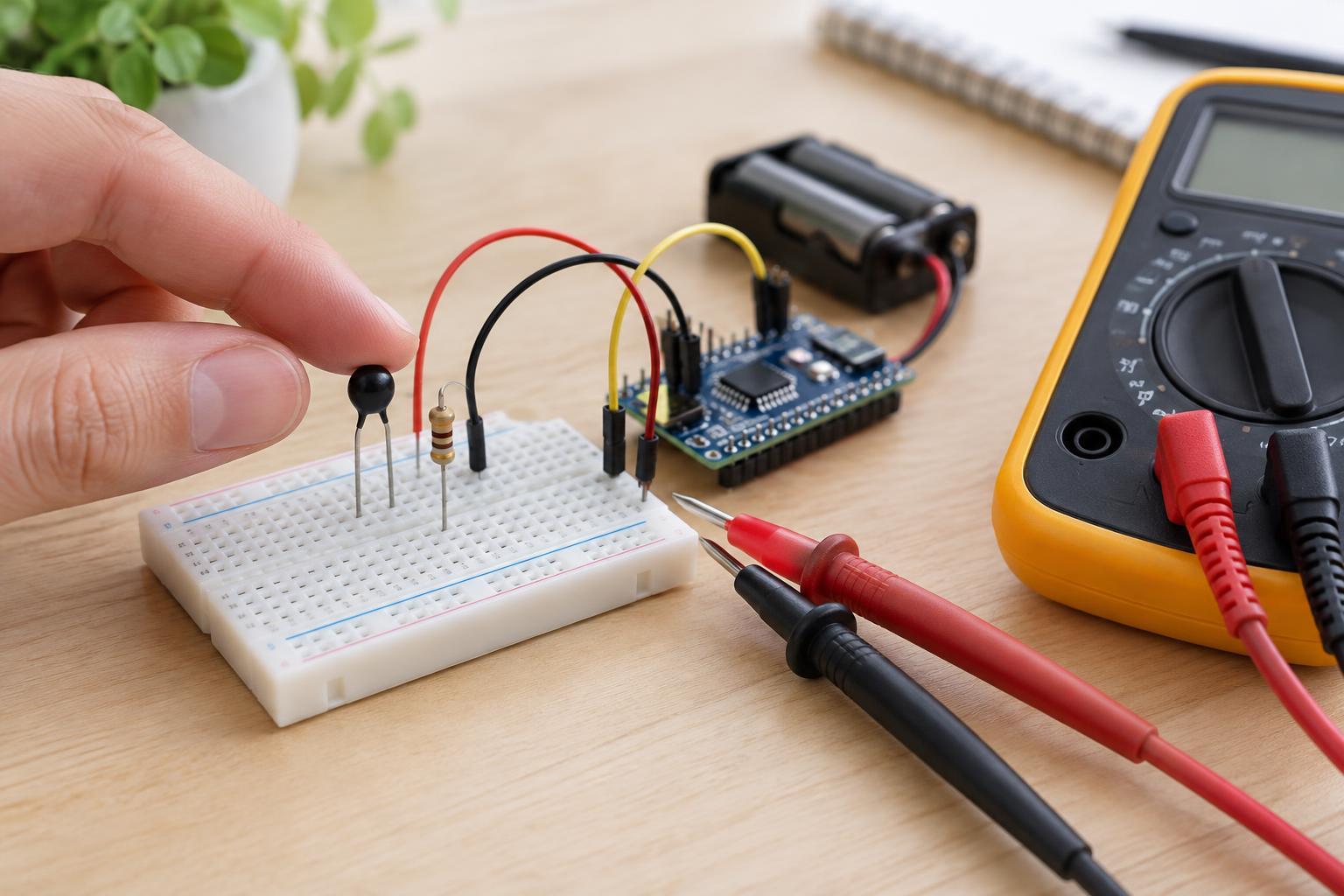
A voltage divider is a straightforward way to use an NTC thermistor with a microcontroller’s analog-to-digital converter, or ADC. Connect the thermistor between a low-voltage supply and the measurement point. Connect a fixed resistor between that point and ground. The ADC reads the voltage at the junction. Use only the supply and input voltages permitted by the controller and its ADC; a 3.3 V input, for example, must not be assumed safe on every device.
With the thermistor on the supply side, warming it lowers its resistance and raises the junction voltage. Swap the positions of the thermistor and fixed resistor, and warming instead lowers the measured voltage. Neither arrangement is inherently better for every project. What matters is recording which component goes where, so the software interprets a rising or falling reading correctly.
Choose a fixed resistor and interpret the reading
For a first low-voltage experiment, a fixed resistor near the thermistor’s resistance at the temperature of interest is a useful starting point. It gives the divider room to produce a noticeable voltage change in that region. If your project cares mainly about a much colder or warmer range, a different resistor value may give more useful ADC readings there. The best choice depends on the thermistor and the range you need to observe.
An ADC normally reports a number representing its input voltage relative to a reference voltage. That number is not automatically a temperature. For a basic demonstration, you can observe whether readings increase or decrease as the thermistor warms. For an estimated temperature, use the resistance-to-temperature information supplied for the specific thermistor, accounting for the divider arrangement and ADC reference. Avoid treating a single room-temperature reading as a full calibration.
Watch for measurement errors
The thermistor measures its own temperature, which may differ from the object or air you care about. Holding it between your fingers warms it; placing it next to a heat-producing component can also affect the result. Give the sensor time to settle after moving it, and keep its position consistent when comparing readings. Long or loose wires may add noise, so check connections before assuming a fluctuating value reflects a real temperature change.
Current flowing through the thermistor produces a little heat. In a simple low-voltage divider this may be small, but it can matter when accurate readings are needed. The fixed resistor’s tolerance, the supply or ADC reference, and differences between individual thermistors can also affect results. Those limits are good reasons to describe an uncalibrated circuit as a temperature indicator rather than a precision thermometer.
Try a bounded low-voltage test
Start with an unpowered breadboard, a suitable thermistor, a fixed resistor, and a controller with an analog input. Wire the divider, check the supply and ground connections, then apply power and record the ADC value at a steady room temperature. Gently warm the thermistor with your fingers and watch which way the reading moves. Disconnect power before changing the wiring. Keep this experiment on a low-voltage supply, away from mains wiring, hot surfaces, and equipment whose safety depends on temperature control.
Temperature has applications well beyond electronics. If this experiment makes you curious about cooking, browse Menus and Pairings · The Urban Table Journal for menu ideas, visit The Urban Table Journal for broader food reading, and explore Ingredients and Techniques · The Urban Table Journal for ingredient-focused reading. Those are avenues for a change of subject, not references for the circuit or its measurements.