Two ways to control voltage
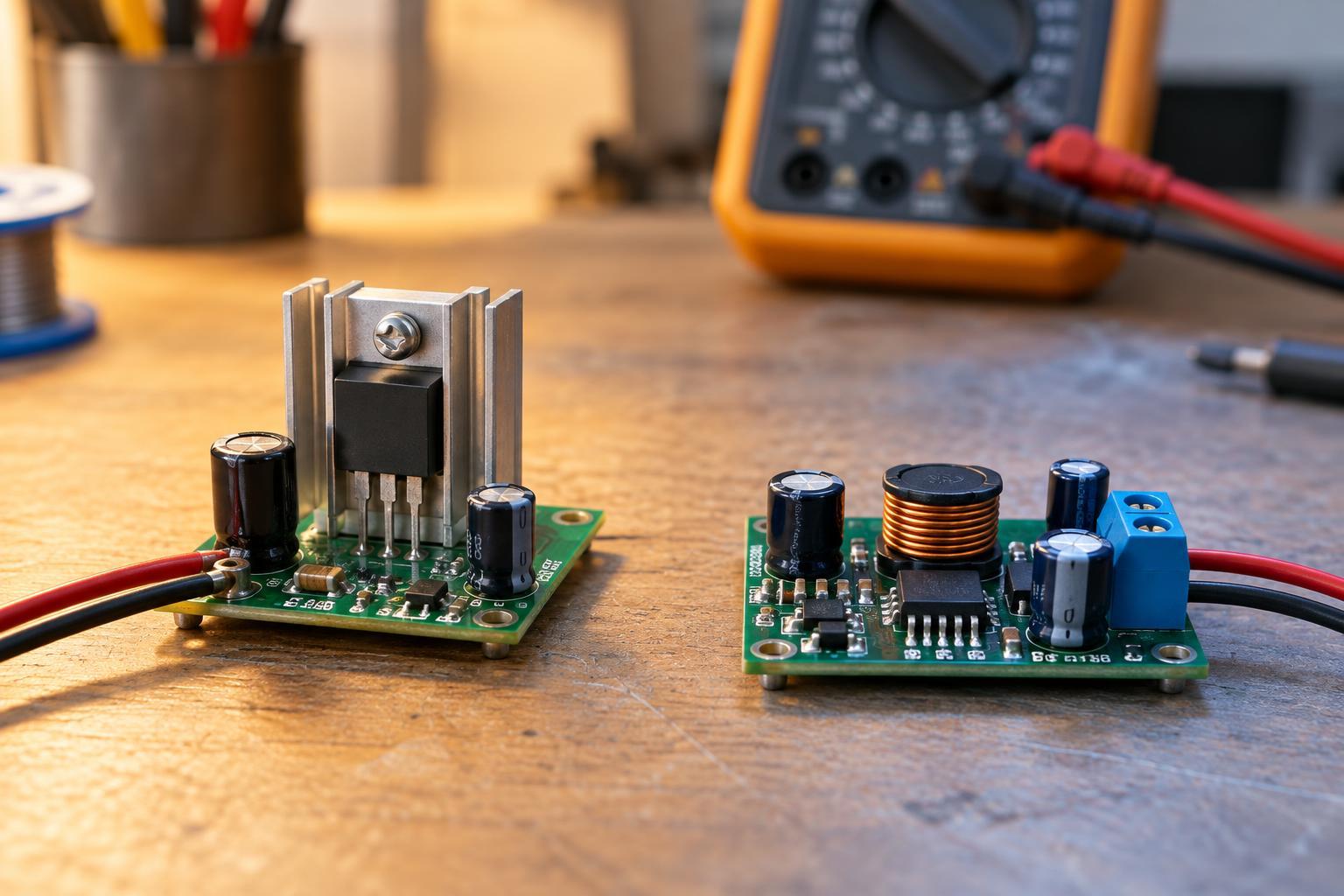
A voltage regulator helps keep a circuit’s supply near its intended voltage as the input or load changes. A linear regulator controls voltage by acting like a variable resistance between its input and output. When its input is higher than its output, the difference is largely converted into heat. A switching regulator repeatedly transfers energy through components such as an inductor and capacitor. By adjusting that transfer, it can often deliver the required output with less wasted power.
Linear regulators only reduce voltage and need some headroom between input and output to regulate properly. This minimum headroom is called dropout voltage. A low-dropout regulator, or LDO, can work with less headroom than some other linear designs, but it still cannot raise the voltage. Switching designs offer more options: a buck regulator reduces voltage, a boost regulator raises it, and other arrangements can do both. The circuit must be chosen for the expected input range, not just its nominal value.
Efficiency depends on the voltage difference
For a linear regulator, a useful first estimate of efficiency is output voltage divided by input voltage, assuming input and output currents are nearly equal. Reducing 12 V to 5 V therefore has a theoretical efficiency of about 42% before accounting for the regulator’s own operating current. Reducing 6 V to 5 V is much less wasteful because the regulator drops only 1 V. This is why “linear” does not automatically mean “inefficient”; the input-to-output difference matters.
A switching regulator can be substantially more efficient when the voltage difference is large or the load draws significant current. Its efficiency is not fixed, however. Losses occur in its switches, inductor, capacitors, and control circuitry, and efficiency may change with input voltage and load current. At very light loads, a particular switching module may use enough power for its own operation that a simple linear regulator is the better choice. Compare specifications at conditions close to those of the intended project.
Heat is a design constraint, not just an inconvenience
The heat produced by a linear regulator is approximately the voltage it drops multiplied by the load current. A 12 V input supplying 5 V at 0.5 A leaves 7 V across the regulator, producing about 3.5 W of heat. That can be too much for a small package without suitable copper area or a heat sink. The output delivers 2.5 W, but the regulator must still get rid of the additional heat.
A switching regulator will usually produce less heat in that situation, though its components still warm up. Neither type should be selected by current rating alone. Check the device’s thermal guidance, package, board layout, ambient temperature, and available ventilation. If a design becomes hot during testing, disconnect power and reassess it rather than assuming the regulator’s built-in protection makes continuous operation acceptable.
What output noise means in practice
Linear regulators generally avoid the periodic switching ripple associated with switching converters, which can make them attractive for sensitive analog circuits. They are not perfectly quiet: their own noise, input disturbances, and load changes can still appear at the output. An LDO’s ability to reject input ripple also varies with frequency and operating conditions, so a label such as “low noise” does not guarantee a quiet supply in every circuit.
Switching regulators can introduce ripple and high-frequency interference. Their layout matters because fast-changing currents can couple into nearby signal traces. Suitable input and output capacitors, a well-routed ground path, and the layout recommended for the chosen device help control these effects. Where a circuit needs both a large voltage reduction and a quiet analog rail, one option is a switching stage followed by a compatible linear regulator. That second stage needs enough input headroom and must still be checked for heat; it will not remove every kind of interference.
Choosing a regulator for a low-voltage project
Start with the full input-voltage range, required output voltage, and highest expected load current. Then consider whether the supply powers noise-sensitive circuitry, how much space is available, and where heat can escape. A linear regulator is often a straightforward choice when the voltage drop and current are modest. A switching regulator is often worth the added component and layout complexity when battery life, a large voltage change, or heat is a priority.
Follow the selected regulator’s datasheet for capacitor values, connections, and layout; parts with similar-looking ratings are not necessarily interchangeable. For hobby testing, stay with an isolated, low-voltage supply and appropriately rated components. Turn power off before changing connections, and remember that capacitors can retain charge after disconnection. A low voltage can still drive enough current to overheat wires or cause a short, so use current limiting or suitable protection while bringing up a new circuit.